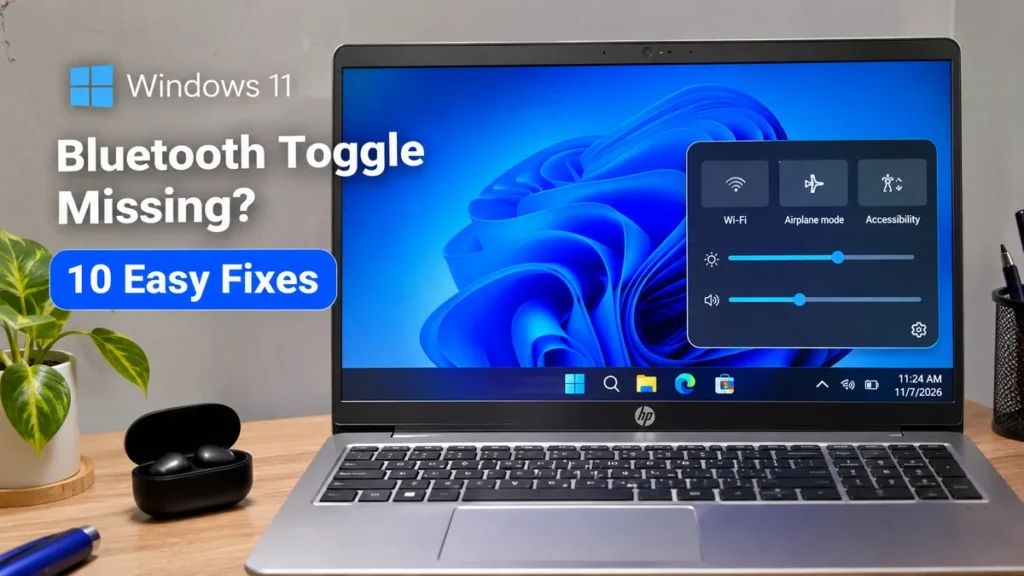
Bluetooth toggle missing in Windows 11? You open Quick Settings or go to Settings → Bluetooth & devices, but the Bluetooth switch has disappeared. You can no longer turn Bluetooth on, pair new devices, or connect your wireless headphones, keyboard, or mouse.
This problem can occur on Windows 11 laptops and desktops from Dell, HP, Lenovo, ASUS, Acer, and other manufacturers. Sometimes, it happens after a Windows update, a driver problem, or a temporary hardware error.
The good news is that a missing Bluetooth option doesn’t automatically mean your Bluetooth hardware is damaged.
Quick answer: If the Bluetooth toggle is missing in Windows 11, first check whether Bluetooth is still available under Settings → Bluetooth & devices. If it’s missing there too, fully shut down your PC, check Airplane mode, run the Bluetooth troubleshooter, and inspect the Bluetooth adapter in Device Manager. Updating the manufacturer’s Bluetooth driver may restore the missing control.
This guide covers 10 troubleshooting methods, starting with the easiest and moving toward more advanced solutions.
Table of Contents
Why Is the Bluetooth Toggle Missing in Windows 11?
Windows relies on your computer’s Bluetooth adapter, its driver, and supporting system components to provide Bluetooth functionality.
If Windows cannot properly detect or initialize the Bluetooth adapter, the Bluetooth toggle may disappear from Settings or Quick Settings.
Common causes include:
- A temporary Bluetooth hardware or firmware error
- An outdated, missing, or incompatible Bluetooth driver
- A Bluetooth adapter disabled in Device Manager
- Airplane mode or manufacturer-specific wireless settings
- A problem following a Windows update
- Bluetooth service or configuration issues
- An internal Bluetooth adapter or USB dongle malfunction
- A computer without built-in Bluetooth support
Before making changes, determine whether the Bluetooth button is missing only from Quick Settings or from Windows Settings entirely.
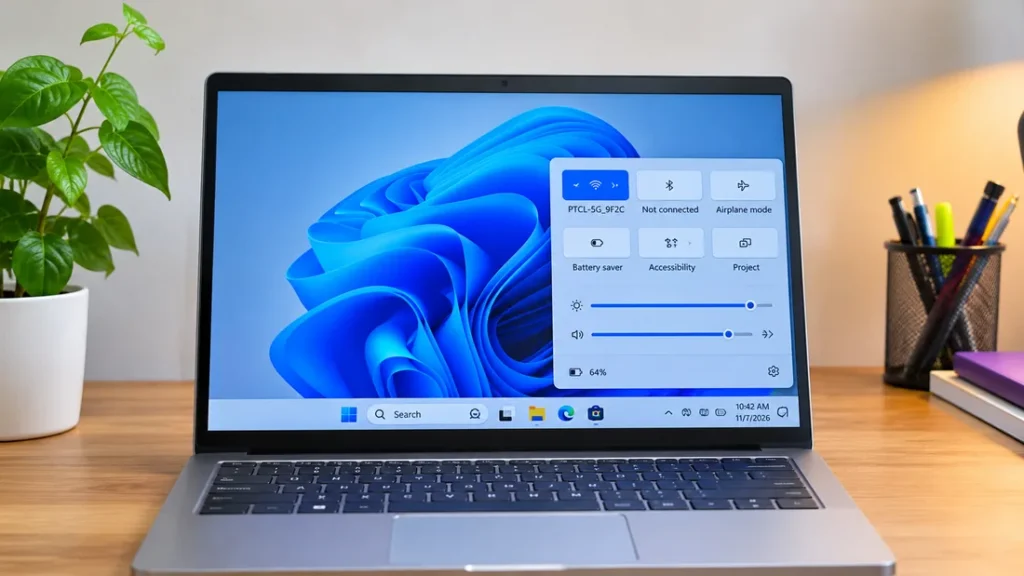
1. Check Whether Bluetooth Is Missing From Quick Settings Only
A missing Bluetooth button in Quick Settings does not necessarily mean Bluetooth has stopped working.
Sometimes, the shortcut is unavailable while the main Bluetooth settings remain accessible.
First, check the main settings:
- Press Windows + I to open Settings.
- Select Bluetooth & devices.
- Look for the Bluetooth on/off switch.
- If the switch is available, turn it on.
- Try connecting a Bluetooth device.
If Bluetooth works here, you probably don’t need to reinstall drivers.
You can also press Windows + A to open Quick Settings and check whether the Bluetooth button is displayed.
Depending on your Windows 11 version, Quick Settings may offer an option to edit or organize available controls.
If the Bluetooth button can be added or restored, use that option.
Important: If Bluetooth is missing from both Settings and Quick Settings, continue with the hardware and driver checks below.
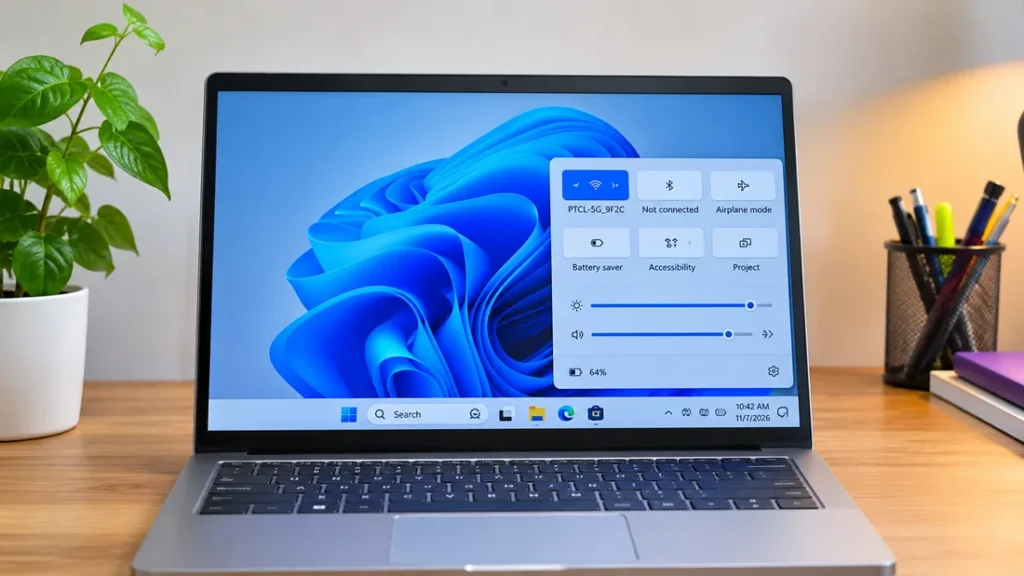
2. Perform a Complete Shutdown of Your Windows 11 PC
A complete shutdown is one of Microsoft’s recommended solutions when Bluetooth disappears in Windows.
Restarting normally doesn’t always clear every temporary hardware state.
Try this:
- Save your work and close running applications.
- Hold down the Shift key.
- While holding Shift, select Start → Power → Shut down.
- Allow your computer to turn off completely.
- Wait approximately one minute.
- Turn the computer back on.
- Open Settings → Bluetooth & devices.
Check whether the Bluetooth switch has returned.
This procedure may help reset a Bluetooth adapter that became unresponsive during a previous session.
If Bluetooth is still missing, move to the next solution.
For additional guidance, see Microsoft’s official Bluetooth disappeared troubleshooting guide.
3. Turn Off Airplane Mode and Check Wireless Settings
Airplane mode can interfere with wireless functionality.
While Bluetooth may sometimes remain available in Airplane mode, the correct starting point is to verify that your PC isn’t preventing wireless connections.
To check:
- Press Windows + A to open Quick Settings.
- Locate Airplane mode, if available.
- Make sure it is turned off.
- Open Settings → Network & internet → Airplane mode if you need to check the setting separately.
- Return to Bluetooth & devices.
Some laptops also have a wireless function key or manufacturer-specific utility.
For example, certain models use a function-key combination to control wireless radios.
Check your laptop manufacturer’s documentation before changing unfamiliar settings.
If the Bluetooth toggle remains missing, the next step is to run Windows diagnostics.
4. Run the Windows 11 Bluetooth Troubleshooter
Windows 11 includes automated troubleshooting through the Microsoft Get Help application.
Microsoft recommends the Bluetooth troubleshooter when Bluetooth controls are missing, disabled, or unavailable.
To run it:
- Open the Start menu.
- Search for Get Help.
- Open the application.
- Search for Bluetooth troubleshooter.
- Follow the guided troubleshooting instructions.
- Apply any recommended fixes.
- Check whether Bluetooth appears in Settings.
Depending on your Windows build, troubleshooting options may also be available through Settings → System → Troubleshoot.
The troubleshooter can help identify certain driver, service, and Bluetooth configuration problems.
However, it cannot repair physically damaged Bluetooth hardware.
If no supported Bluetooth hardware is detected, continue by inspecting Device Manager.
5. Check Whether Bluetooth Appears in Device Manager
Device Manager is one of the most useful tools for investigating a missing Windows 11 Bluetooth toggle.
It helps you determine whether Windows recognizes a Bluetooth adapter.
Follow these steps:
- Right-click the Start button.
- Select Device Manager.
- Look for a category labeled Bluetooth.
- Expand it if available.
- Find the Bluetooth adapter, which may have a manufacturer name such as Intel, Realtek, or MediaTek.
If Bluetooth appears
Windows has a device entry for Bluetooth.
Check whether the adapter has a warning icon or appears disabled.
A warning icon can indicate a driver or device problem.
If Bluetooth does not appear
Select View → Show hidden devices.
A hidden Bluetooth entry may represent a previously installed device rather than hardware Windows currently detects, so its presence alone doesn’t prove that the adapter is working.
You can also select Action → Scan for hardware changes.
If Bluetooth remains absent, check Other devices for unidentified hardware.
Don’t install random drivers based only on an unknown device entry. Identify the correct computer model and hardware first.
A completely missing Bluetooth adapter may indicate a driver, firmware, connection, or hardware problem.
6. Enable the Bluetooth Adapter if It Is Disabled
Sometimes, Windows recognizes the Bluetooth adapter but lists it as disabled.
In that situation, enabling the adapter may restore Bluetooth functionality.
To check:
- Open Device Manager.
- Expand Bluetooth.
- Right-click the Bluetooth adapter.
- Look for Enable device.
- If that option appears, select it.
- Recheck Bluetooth in Windows Settings.
If the context menu displays Disable device instead, the adapter is already enabled, so don’t disable it unnecessarily.
Also, avoid changing unrelated Bluetooth device entries when you aren’t sure which one represents the actual adapter.
If the adapter is enabled but Bluetooth remains unavailable, investigate the installed driver.
7. Update the Bluetooth Driver
Outdated, corrupted, or incompatible drivers can cause Bluetooth controls to disappear.
This is particularly relevant when the problem begins after a Windows update or when Windows no longer recognizes the Bluetooth hardware correctly.
Update through Device Manager
- Right-click Start → Device Manager.
- Expand Bluetooth.
- Right-click your Bluetooth adapter.
- Select Update driver.
- Choose Search automatically for drivers.
- Follow any instructions shown.
- Restart the computer if prompted.
If Windows reports that the best driver is already installed, that doesn’t necessarily mean the manufacturer has no newer version.
Get drivers from the PC manufacturer
Visit your PC manufacturer’s official support website.
For example:
- Dell Support
- HP Support
- Lenovo Support
- ASUS Support
- Acer Support
Search using your exact computer model or service identifier.
Download a Bluetooth driver specifically compatible with your hardware and Windows 11.
Avoid unofficial driver-download websites and applications promising to fix all drivers automatically.
If Bluetooth is missing from Device Manager, you may need to install the correct manufacturer driver directly rather than updating an existing device entry.
See Microsoft’s instructions for updating Bluetooth drivers.
8. Check Windows Update and Optional Driver Updates
Windows Update can provide Bluetooth driver and compatibility updates.
If Bluetooth disappeared after an update, installing a subsequent compatible driver or Windows fix may resolve the issue.
To check:
- Press Windows + I.
- Select Windows Update.
- Click Check for updates.
- Review available updates.
- Install appropriate updates and restart if requested.
Next, check optional updates:
- Open Windows Update → Advanced options.
- Select Optional updates.
- Review any available driver updates.
- Install only updates relevant to your PC and Bluetooth hardware.
Some optional updates may include firmware or other device components.
Caution: BIOS and UEFI firmware updates require particular care. Use only instructions and packages provided for your exact computer model, and don’t interrupt the update process.
If Bluetooth disappears immediately after a driver update, check the adapter’s Properties → Driver → Roll Back Driver option in Device Manager.
Rollback is available only when Windows retains an appropriate previous driver.
9. Restart the Bluetooth Support Service
Windows uses background services to support Bluetooth discovery and communication.
If the Bluetooth Support Service is not functioning properly, some Bluetooth operations may fail.
You can check the service using the Windows Services console.
- Press Windows + R.
- Type
services.msc. - Press Enter.
- Locate Bluetooth Support Service.
- If the service is running, right-click it.
- Select Restart, if available.
- If it is stopped, review the service configuration before starting it.
- Check Bluetooth Settings again.
The available service controls depend on your Windows configuration.
Bluetooth services may use manual or trigger-based startup. A service not running continuously is not automatically evidence of a fault.
Avoid changing several Bluetooth services to Automatic without understanding their intended configuration.
Important: Restarting a service will not restore a missing or physically damaged Bluetooth adapter.
If Bluetooth is absent from Device Manager, driver and hardware troubleshooting should take priority.
10. Reinstall the Bluetooth Driver or Check the Hardware
If the Windows 11 Bluetooth toggle is still missing, reinstalling the adapter driver may help.
Try this only after the simpler methods, especially when Device Manager shows a Bluetooth adapter with a driver error.
Before reinstalling
Download the correct Bluetooth driver from the manufacturer’s website if possible.
This is important because an automatic driver reinstall isn’t guaranteed to succeed, particularly when Windows cannot access the internet.
Reinstall the driver
- Open Device Manager.
- Expand Bluetooth.
- Right-click the Bluetooth adapter.
- Choose Uninstall device.
- Confirm the uninstall.
- Shut down the computer.
- Turn it back on.
- Allow Windows to detect the adapter and reinstall an appropriate driver.
If Windows doesn’t detect the adapter, open Device Manager and select Action → Scan for hardware changes.
You may need to install the manufacturer’s Bluetooth driver manually.
What if Bluetooth is completely missing?
Check the following:
- Does your computer actually have a built-in Bluetooth adapter?
- Is a removable USB Bluetooth dongle properly connected?
- Does your manufacturer provide a wireless hardware diagnostic?
- Is Bluetooth disabled through an OEM-specific firmware setting?
- Does the adapter appear in Device Manager after a complete shutdown?
On some computers, Bluetooth or wireless hardware can be controlled through BIOS or UEFI settings.
Only inspect or change these settings using your manufacturer’s instructions.
If Bluetooth still isn’t recognized after the correct driver and firmware checks, contact the PC manufacturer or a qualified technician.
A Windows reset or complete reinstall should not be the first response to a missing Bluetooth toggle.
Bluetooth Toggle Missing in Windows 11: Quick Troubleshooting Table
| Problem | What to check |
|---|---|
| Bluetooth button missing from Quick Settings only | Bluetooth & devices and available Quick Settings controls |
| Bluetooth missing after sleep or restart | Complete shutdown |
| Bluetooth disabled by wireless settings | Airplane mode and manufacturer wireless controls |
| Bluetooth visible but disabled in Device Manager | Enable device |
| Bluetooth shows a warning icon | Bluetooth driver and device status |
| Bluetooth missing after Windows update | Driver updates or rollback |
| Bluetooth absent from Device Manager | Hardware detection, manufacturer driver, firmware |
| USB Bluetooth dongle not recognized | USB connection, dongle compatibility, driver |
| Bluetooth troubleshooting finds no adapter | Manufacturer diagnostics and hardware support |
Bluetooth Missing From Device Manager vs. Bluetooth Missing From Quick Settings
These two problems are not necessarily the same.
Bluetooth is missing only from Quick Settings
If Bluetooth still appears under Settings → Bluetooth & devices and you can connect accessories, the hardware is likely functioning.
Focus on the Quick Settings interface rather than reinstalling drivers.
Bluetooth is missing from Device Manager
If the Bluetooth category is missing entirely and scanning for hardware changes doesn’t restore it, Windows may not be detecting a functioning Bluetooth adapter.
In this case, investigate the manufacturer’s drivers, firmware, hardware switches, and physical adapter.
Understanding the difference helps you avoid unnecessary changes.
Frequently Asked Questions
Why is the Bluetooth toggle missing in Windows 11?
The Bluetooth toggle may disappear when Windows cannot detect or initialize the Bluetooth adapter, when a driver is damaged or incompatible, or when Bluetooth hardware is disabled. A missing Quick Settings shortcut can also be an interface issue rather than a hardware failure.
How do I get my Bluetooth button back on Windows 11?
Start by checking Settings → Bluetooth & devices. If Bluetooth is missing there, perform a complete shutdown, check Device Manager, run the Bluetooth troubleshooter, and update the manufacturer’s Bluetooth driver.
Why did Bluetooth disappear after a Windows 11 update?
A driver or firmware compatibility issue may occur after an update. Check Device Manager and Windows Update for compatible drivers. If available and appropriate, rolling back a recently updated Bluetooth driver may help.
What should I do if Bluetooth is missing from Device Manager?
Use View → Show hidden devices and Action → Scan for hardware changes. Then check the PC manufacturer’s support website for the correct Bluetooth driver. If Windows still cannot detect the adapter, consider a hardware or firmware problem.
Can Bluetooth disappear because of Airplane mode?
Airplane mode can interfere with wireless connectivity, although its exact behavior depends on the device and configuration. Turn Airplane mode off and check whether the Bluetooth toggle returns.
Will reinstalling the Bluetooth driver fix the missing toggle?
It can resolve some driver-related problems, but not every case. Reinstalling a driver will not repair a defective Bluetooth adapter or provide Bluetooth functionality to a PC without compatible hardware.
Can I use a USB Bluetooth adapter if my PC has no Bluetooth?
Yes. A compatible USB Bluetooth adapter can add Bluetooth capability to many Windows 11 desktop computers and laptops. Confirm Windows 11 compatibility and follow the manufacturer’s installation instructions.
Is it safe to reset Windows to fix Bluetooth?
Resetting Windows is a significant step that can affect installed applications and settings. It should not be your first troubleshooting method. Check drivers, updates, and hardware compatibility before considering operating-system recovery.
Final Thoughts
If your Bluetooth toggle is missing in Windows 11, start by determining whether the problem affects only Quick Settings or whether Windows can no longer detect Bluetooth hardware.
A complete shutdown, Airplane mode check, and Windows Bluetooth troubleshooter are sensible first steps.
If Bluetooth remains unavailable, Device Manager and the manufacturer’s Bluetooth drivers are the next places to investigate.
Avoid installing unknown drivers or resetting Windows before identifying the actual cause.
For other wireless connectivity problems, explore our related guides:
- MacBook Bluetooth Not Working? 12 Best Fixes
- iPhone Bluetooth Not Finding Devices? 11 Fixes
- iPad Bluetooth Not Working? 12 Best Fixes
These articles cover similar wireless troubleshooting issues on other devices.
For Windows 11 specifically, start with Microsoft’s official Bluetooth troubleshooting resources or contact your PC manufacturer if the adapter cannot be detected.